Monday, March 30, 2015

Is It Time for Spring Cleaning?

I’ve never been one of those who enjoys cleaning my home and keeping it organized. And yet, I’ve found over the years that I function better and am happier when my living and working environments are neat, tidy, and clean. Now that I am retired, you’d think it would have become simpler to maintain order here at home... but it has not! It’s by no means the proverbial pigsty my mother used to occasionally compare my messy childhood room to, but it’s typically not as organized and company-ready as I’d like. From as far back as I can remember, spring has been the traditional time to do a really thorough housecleaning.

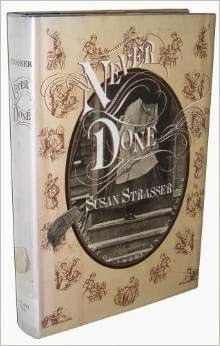
My local newspaper recently featured information from a book about the history of house cleaning, Never Done: a History of American Housework, by Susan Strasser, a local professor emeritus of history. (She has written some books that sound fascinating, by the way, including a history of trash!) Then, as now, where winter weather is cold, people keep their windows tightly shut to conserve warmth. But when coal and wood were used to heat homes, and kerosene and candles were used for lighting, a lot of dirt accumulated during the cold season. It wasn’t just dust - oily soot had to be removed from surfaces, and that was hard work. Spring cleaning was an absolute necessity back then. According to Strasser, women would typically set aside a full week, and work daily, from dawn to dark, on their spring cleaning.

There were no vacuum cleaners back then. No rug shampooers, Swiffers, or even washing machines. Before water was piped into homes, the water for cleaning often had to be fetched in buckets from the nearest hydrant, well, or creek, and then heated on the stove. After use, dirty water had to be carried back outside and dumped. Rugs and upholstered furniture were hauled outside to be cleaned. Rugs were hung and beaten with paddles, and upholstered furniture was wiped down and/or brushed thoroughly. Every interior surface, including walls, floors, windows, cabinets, and furniture, was scrubbed during that week.

There was no Mr. Clean, either, so women usually had to make the soap they used for cleaning. Sand and salt were sometimes used for scouring, and vinegar provided yet another cleaning aid. So time consuming was this cleaning that families had to make do with cold dinners, because women didn’t have time to cook when spring cleaning was going on.

Nowadays, even those of us who perform a spring cleaning ritual can have a hot dinner. We are indeed very fortunate to live in an era where so much less indoor grime is caused by heating and lighting, and cleaning is so much easier. In fact, many Americans no longer do spring cleaning at all, but rather do the “deep cleaning” incrementally, from month to month, or as the need arises.

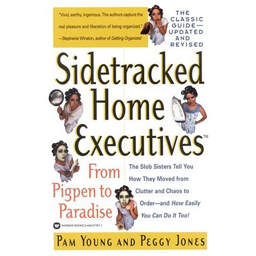
Back in 1977, Pam Young and Peggy Jones wrote their defining book on the new, incremental approach to keeping your house clean: Sidetracked Home Executives. In it, they advised women to set up a schedule for cleaning and other household tasks, and to spread out tasks that used to be included in spring cleaning over the months. They recommended keeping track of housekeeping jobs in a 3x5” cardfile, something I still do to this day (albeit intermittently). It was a good system, though, and helped a lot of women (and men) to get organized around the home. Peggy has retired, but Pam is still writing and inspiring from her website, Make it Fun and It Will Get Done.

Following up on Pam and Peggy’s no-spring-cleaning methods was the Flylady, known in real life as Marla Cilley. Marla also published her own book on the subject, Sink Reflections. The Flylady program has well over half a million followers worldwide, and features a free website with detailed instructions for achieving a clean and organized home. Many people sign up for free Flylady e-mail that puts reminders and task lists right in their inboxes. Pam Young is a regular participant in the website, too.

Well... to spring clean or not to spring clean? It’s still a little too early here in Delaware, where temperatures are dipping below freezing many nights and it’s too cold, yet, to open the windows. I mostly follow the Pam Young-Peggy Jones and Flylady recommendations for not doing too much all at one time. I think that’s particularly good advice for retirees, because we now have the time to do a little “deep cleaning” every day, and don’t have to set aside weekends or vacation time to get it done (been there, done that). Also, getting on ladders and scrubbing and moving furniture is hard work, and doing too much at one time can cause sore muscles and joints. I know my hands, particularly, get very sore if I do too much scrubbing.

But even though I’ll have to wait for a month or so till the weather warms up and I can open the windows while using strong cleaners, I’m already thinking about scrubbing tile, shampooing carpets, washing slipcovers, and hanging dusty blinds outside to wash them down.

Coming up: Is it worth your time to make homemade household cleaners?

Friday, March 27, 2015

You Can Still Get Free Tax Help

Volunteers have taken over the big meeting room at the library where I teach and do volunteer tutoring, and there has been a steady stream of people flowing in to have their taxes done, sometimes with shoeboxes or bags of receipts in hand. Like every year, they'll be coming in right up until April 15. Yes, the US tax filing deadline is looming - not much more than two weeks away!

One nice thing about being retired on a small income is that you may not even need to file a return! There’s always a silver lining. But if you need help doing your taxes, assistance is going to be a little harder to find this year, especially from the government.

The IRS has traditionally offered assistance through both walk-in centers and phone assistance. But according to recent news stories, such as this one in the Washington Post, the number of taxpayers having trouble getting through to an IRS agent for assistance over the phone has been at an all-time high this year. And the IRS has warned that the availability of in-person assistance at local Tax Assistance Centers will be very limited. As reported in Forbes, the IRS is attempting to establish an appointment system at some centers, but they are blaming budget cuts plus a large burden of new work related to the Affordable Care Act for their inability to provide much tax assistance this year.

Fortunately, there are a number of other sources of free tax assistance available to those with lower incomes (usually under $53,000) and relatively uncomplicated tax situations. And it's not too late to get help!

The IRS’s website provides links to Volunteer Income Tax Assistance (VITA) and Tax Counseling for the Elderly (TCE) program locations around the country.
These centers are staffed by IRS-certified volunteers.

The AARP Foundation also provides volunteer-staffed programs for free tax filing assistance, for all ages, at centers around the country. You can find out more about the program and locations at the AARP Foundation Tax Aide program website.

In addition, there are other non-profit organizations that work at libraries and other community centers to help qualifying taxpayers prepare and electronically file their returns. In my area, the libraries will give you a list of tax preparation programs with locations, days and hours, and phone numbers to get information and make appointments. Some centers do offer appointments, while others operate on a walk-in basis. Since I tutor and teach at the library several times a week, I’ve seen floods of people come in to have their taxes done by one of several groups, and I’ve never heard anyone complain about the help they got. If you want to find free local tax filing that may not be included on the IRS lists, I’d start by calling your local library and senior center.

You can prepare your own tax returns using free online software that will electronically file your return. I’ve always done my own taxes and have found that the commercial online electronic services have gotten better and better over the years. My only complaint has been that the online no-cost filing forms sometimes aggressively try to steer you to choose options that you have to pay for, and that can get very annoying! However, they are easy to use, do a good job, do all the work of filing for you, and seem to be pretty reliable in terms of sorting out deductions and stuff like that. Plus, you don’t have to keep checking and rechecking your math to avoid errors. Here are the three top free commercial services that received top user votes in a survey published by Lifehacker.com. Keep in mind that although these providers offer free basic preparation and e-filing, they will charge you for additional services, including state taxes and other add-ons. And as I found, they can be pretty aggressive and even tricky in trying to convince you that you need and should pay for those extras.
  • Turbotax was the most popular free tax return preparation tool in Lifehacker’s survey.
However you do it, be sure to file your return by the deadline. Because paying penalties isn't frugal. 

Wednesday, March 25, 2015

Don't Be a Pathetic Old Person

If you've been reading this blog, you know that I like to find ways to enjoy myself, to make myself feel happy and optimistic. Don't you know a lot of old people who complain all the time, who always have a million things wrong in their lives and no hesitation about sharing? They always seems so pathetic, even when they genuinely do have a lot of problems. Most of us have a natural instinct to avoid others who are needy and depressing.

One important tenet in practicing stealth frugality is to not seem pathetic. Seeming needy, pitiable, and unhappy can be an easy trap to fall into, especially when you're old, definitely not feeling 21 any more, and trying to live on a small income. But pathos is just not necessary, even when you have a lot to be sad or worried about. Optimism is a learned skill, and using it benefits both you and everyone around you.

I guess old people have always been infamous for harping on their illnesses, aches, and pains. I can remember family gatherings back when I was a kid, wondering why the old folks talked so much abut their infirmities. It was puzzling and a little repellent to me at the time. Nowadays, it doesn't surprise me all that much, but I still find it somewhere between annoying and repellent. What ever happened to the virtues of stoicism? Do some folks think it's no longer operative when you hit 65? Has their world become so small and involuted that they don't have anything to talk about but their illnesses, aches, medications, and doctor's appointments?

I've been thinking about this recently, because a friend's birthday fell on Thursday of last week. And I really, really did not want to call her. I steeled myself and did it anyway. Sure enough, after a cursory "And how are you, my dear?" she was off and running with a litany of health problems, financial problems, and complaints about her children. The children, of course, have as little to do with her as possible. And who can blame them? First they have to listen to tales of her health woes, many exaggerated in hopes of engendering sympathy, and then they are hit up for money.

I just don't ever want to be that way, no matter how bad things get. I don't think it's prideful to want NOT to seem pathetic or a leech. That's not to say that we should never ask others for help if we need it, by the way. But we haven't obtained a free pass for mooching and grumbling and general selfcenteredness just by virtue of having lived for more than 60 years. Instead, it's fully my own responsibility to do my best to keep myself healthy, happy, and solvent.

Next week, I'll write about some of the ways I've found to avoid becoming a pathetic old person. It really does make life nicer for everyone.

Sunday, March 22, 2015

The Reward-Yourself Trap

Because We Can Get You to Pay a Lot More!
I had just come home from the library last Tuesday, where I tutored for several hours. It was a 25-minute walk each way, and I was bushed. And the first thing I did was to fix a big mug of strong, hot tea with milk. It seemed like a little reward, although It was just plain Jane Lipton... a thrifty reward.

I've been thinking about how we tend to reward ourselves a lot these days, and how the rewards often add up to quite a bit of money. We've become a more hedonistic society in many ways, but I think advertising has played more than a small role in fostering this reward thing.

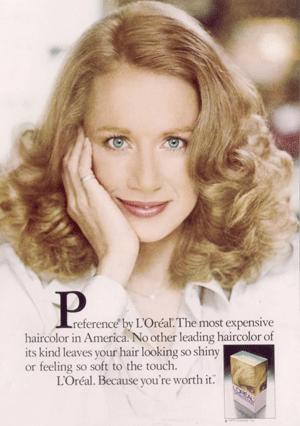
"Go on, you're worked hard... you deserve it!" Don't we hear variations of this theme in advertisements for everything from beer and fast food to shampoo and coffee drinks? Who can't remember the L'Oreal ads that urged you to splurge on their more expensive hair color... "Because you're worth it"? I used to color my hair, and I honestly noticed very little difference between brands, other than the conditioner packets that came with different brands.

That theme, that mindset... spend more on yourself, buy the more expensive item... you deserve a special little treat... you need it to brighten your day, to reward yourself for all your hard work... or just because... was picked up and continues to be used, either directly or implicitly, by a host of advertisers and their handmaidens in journalism and social media.

Clearly these Madison Avenue-inspired blandishments have worked over the years to get us to spend more and more on all the little things we use during the day. I'm not sure when my focus was first directed to this fact... I think it may have been something from Suze Orman decades ago. But it's stuck with me, and I've learned to filter some of my buying decisions through it.

Remember when you just bought a plain bar of (inexpensive) soap? Maybe Ivory, or a generic store brand. But for many people that's not good enough any more. We want "special" soaps - with lotion, or deodorants, and costing 50% more. Or we want specially scented soaps that cost 5 or 10 times as much as that bar of Ivory. Leafing through a magazine yesterday, I saw suggestions for perfumed soaps that cost $10 a bar. But... don't you deserve to have a really great scent in your morning shower? Isn't starting the day with something that makes you feel good worth the price? Uh... not necessarily.

We're being continuously upsold on everything these days. We don't just buy a jar of instant coffee, or a pound of ground Maxwell House. We buy special organic custom dark roast beans from wherever, at three or more times the price. Or we have to have K-cups that allow us to brew ever-more-expensive cups of coffee using even more expensive equipment. We don't buy the inexpensive Banquet frozen pot pie for 75 cents, but rather the big, luxurious Marie Callendar pot pie for three or four times Banquet's price, even though it has too many calories, is no more nutritious, and actually doesn't taste much better. We no longer want to eat boring old American cheese, either - we "deserve" imported gruyere, extra-sharp Vermont cheddar, or goat cheese, all at prices double (or quadruple) that of the American cheese.

OK, so the special roast really is better, and perhaps the Marie Callendar pie is a little tastier.  The gruyere is definitely delish. None of these choices is bad in and of itself. The problem is that as a society we've come to do this with everything. And as a result, we're spending more, way more, on our needs. At the grocery store, at the drug store, everywhere and on everything.

Those of us who have hit retirement age can remember when we (or our parents) mostly just bought basic items. Sure, we usually had the choice of several brands, but not the enormous choice offered today. We bought basic ingredients and created delicious meals, without using packets of expensive "special" spice mixes or "gourmet" sauces from jars. We bought plain coffee, plain soap, plain jelly or jam, and only occasionally did we "splurge" on something less basic. Splurges were the exception, not the rule that they have become.

And sometimes the splurges are a rip-off. I remember reading about a study of women's face creams ranging in price from a few dollars to over $100 a jar. Objectively, despite the claims in glossy magazine ads, no advantage was found in using the expensive creams. The best results came from one of the less expensive brands. The more expensive house cleaning products are sometimes a little more effective than the old fashioned, cheaper brands, but they also often contain more toxic ingredients. Often we're better off health-wise by sticking with more frugal, less hazardous products or even the old-fashioned staples of soap and vinegar and baking soda.

I like good coffee, but long ago decided to use a store-brand instant most of the time. My rationale is that when I make good coffee, I drink too much, so the instant is better for my health. Once in a while I have a cup of really good coffee and it's quite a treat, but I don't need to treat myself every morning. I also find the cheapest bar soap gets my skin just as clean as expensive scented soaps. I get my fix of a good scent on mornings when I shampoo my hair, because I buy inexpensive shampoos that come in a variety of wonderful aromas - I'm currently luxuriating in a coconut hibiscus-scented shampoo from White Rain, which I got at a dollar store. And by the way, my experience says that the $1 shampoo cleans my hair just as well as the $6.95 brand. I like a good gruyere now and then, but I mostly use a standard American-type cheese for cooking and eating, and it tastes just fine with my apple slices.

Living well on a small income requires finding good, or at least acceptable, low-cost staples, and then deciding, based on personal priorities, where you want to occasionally splurge. Advertising, and our friends and family who mindlessly follow advertising's dictates, will tell us to splurge on everything... because we deserve it. I'm not saying it's wrong to splurge, but it's our tendency to splurge on everything that has contributed to an unnecessarily high cost of living. Constant splurging - 'cause you deserve it! - is a trap that can ruin our budgetary goals. The good news is that we can substantially reduce our cost of living by giving a little more thought to what we choose to buy, and what we decide to splurge on.

Saturday, March 21, 2015

Free Text Messaging from Your Computer

It's Saturday morning, the first full day of spring, and there's an inch of snow on the ground. That's just wrong! I will teach a class at the library this afternoon, and I expect to get at least one or two text messages from students. "I'll be late to class." "Sorry, teacher, I can't come to class today."

Have you noticed that everybody under the age of 50 texts these days? It seems like nobody makes actual telephone calls any more. My oldest grandson doesn't like phone calls at all... he would much rather text back and forth, even with his grandmother. Now, because of my volunteer teaching and tutoring, I regularly have to send and receive a lot of text (SMS) messages. And I have come to just hate typing on the teensy little keyboard on my Blackberry. I know I'm not alone in this!

So even though my Virgin Mobile cellphone plan provides unlimited free texting, I use my computer to send texts whenever I can because it’s just so much less frustrating. And I've started using Google Voice for that because it lets me both send and receive text (SMS) messages... for free. And the best of all is that you can set it so that it sends a copy of every received text message to your e-mail. Before, I sometimes used Skype for texting, but they charge me for every text sent, and I cannot receive texts on Skype.

This Google Voice text message service is yet another useful, free service that a lot of folks don't know about. I've been successfully using various parts of Voice for a few years now. I have been sending all my text messages through Voice recently, and am so happy with it that I think it's time to share.

Now, if I still had an Android phone I could just send and receive texts from either my phone or my computer. But I'm still using my old Blackberry (I dropped and broke my shiny new Android phone a while back and returned to using the Blackberry) and there is no Voice app for it. I can't send texts from Google Voice from my phone. But no problem! When I leave the house and a time-sensitive text message comes in (Teacher, I can't come to our tutoring session that starts in 5 minutes. sorry!), the text will appear in G-mail on my Blackberry, clearly marked as a text message. I can check e-mail as quickly on my Blackberry as I can text messages, and that's true of any even semi-smart phone. If I need to reply, I can wait till I get home or send a reply text from my Blackberry phone number.

When I am at home, and a text comes in to my Google Number, I get both a Google popup on my computer screen and an e-mail with the text message. I’ll also see it if I check e-mail from my tablet. Unlike a lot of young people, I don’t carry my cell phone around the house with me all day and I may not remember to look at my phone for hours, but I’m usually on the computer and tablet more often. So I'm less likely to miss a text that comes to my Voice number.

Another thing I like is that my Google Voice inbox, accessed from my computer, keeps a searchable record of every text I send and receive. I can go back several years if I want, unlike my phone where text messages just kind of roll off and disappear after a week or two. In addition, I keep all my contacts in G-mail, and the list both syncs with my Blackberry and is available on any other device on which I can sign in to Google. That makes it very easy to find cell phone numbers of the individuals I need to text, no matter where I am.

Now, every aspect of this Google Voice setup is completely free. To send text messages to cell phone numbers, you’ll need to first get a Google account and then a Google Voice number. You can usually get a number with your own area code. You can read all about how to get your very own Google VOIP (Voice Over Internet Protocol) phone number by going to the Google Voice website. They make it pretty easy, but Voice has a lot of features, most of which you don't need to send or receive texts. I've tried most of what they offer... some things worked better than others for me, but so far the texting has been flawless.

I should mention that Google will encourage you to link your Google Voice account with Google Hangouts, which is a (free) video call/conferencing service, similar to Skype. I'm a big fan of Hangouts, too - I use it for video tutoring and like it quite a bit better than Skype these days. But I don't want to be texting or receiving texts from the Hangouts app. Google Voice and it's own, separate extension seems to be a lot easier to use when I'm sending texts to people who are not signed up for Google, let alone Hangouts. So don't connect Voice and Hangouts, would be my advice. (You will still be able to send text messages, from within Hangouts, to the person you're talking to on a video call.)

This all sounds a little fiddly, doesn’t it? But actually it’s pretty easy. I will admit to being a bit of a Google fangirl, but this really is a very useful product, and free is frugal, too. Five stars to Google for its Voice service!