Thursday, November 27, 2014

Gratitude

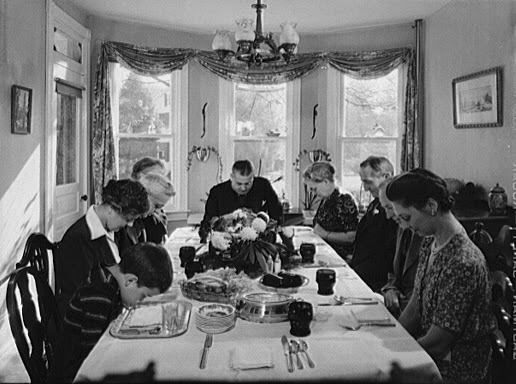
Thanksgiving Grace: 1942
This annual coming-together to think and express what we're thankful for is pretty much a uniquely American phenomenon. As a nation, right from our beginnings we've understood the value of recognizing and expressing gratitude for our blessings.

But the individual and daily exercise of gratitude has become even more important to me as part of the process of creating a good life.

Now, gratitude is the subject of a lot of books and countless articles. In addition to its spiritual and psychological benefits, gratitude is even recommended as part of the "manifestation" process described in The Secret and similar books. As in, if you get it and aren't grateful, the universe will stop being so generous.

At minimum, being grateful does move your focus to the positive. And I think much of how we evaluate the quality of our lives is a function of that focus. It used to be popular to pooh-pooh the supposedly saccharin story in the children's book Pollyanna, by Eleanor H. Porter, but I've found a lot of benefit in that approach. You notice what you're focusing on, and that can really change your perception of how things are. And with a bit of consistent effort, you can change your focus. One way to do that is to consciously practice gratitude on a daily basis. Some people keep gratitude journals as part of that practice. By the way, I'd recommend a re-read of Pollyanna... I read it again a few years ago and thoroughly enjoyed its charming story. And if you're trying to summon up more gratitude, it will definitely reinforce your effort.

Changing your focus to what you're grateful for is also recommended as a key strategy by self-help guru Tony Robbins. He stresses, over and over in his work, that what you focus on is what you get more of.

So perhaps there is some kind of woo-woo magic, per The Secret, in focusing on what you want, in order to manifest it. Or maybe it's just a psychological phenomenon that whether you focus on good things, or undesirable things, your subconscious will "help you" by working behind the scenes to bring you that which you're focusing on. And religious folks, of course, will realize the spiritual discipline of being grateful for whatever is brought into your life.

Today I'm grateful for many things. Among them is the ability to be profoundly grateful for what I have.


Sunday, May 4, 2014

Paperback Book Swap... a Good Deal?

One of my friends is very enthusiastic about Paperback Book Swap. She uses it a lot and is delighted with it. She says she often trades in paperback books and gets recent hardback books in return, which she then donates to our library after reading. One day she brought in a very interesting knitting book that she had gotten through Paperback Book Swap. I resisted for quite a while, mainly because packaging up my swap books and taking them to the post office seemed like kind of a hassle.

Well, I finally decided to try it. I went to the website, Paperbackswap.com, and signed up... it's a pretty good website, signup was easy, and although navigation could be better, it's OK. I entered a number of my books as available, which was really simple using the ISBN numbers. The only time it got a little trickier was when I entered a very old book that wasn't on their list. I had to put in a lot more information for that one.

Next, I checked my wish lists at the library website and Amazon.com, and put in requests for a number of books I've been wanting. Within a short time, I got quite a few requests for my books! I printed the labels with postage from the website, and packaged them in various saved manilla and shipping envelopes I'd saved. You can buy postage from the website, and then use it to print a label with postage already on it. The amount is calculated from the book info. Thus I did not have to go to the post office at all, just trot over a couple blocks to the nearest post box. Easy peasey.

So that was the positive. Every person I requested a book from shipped it promptly. Every book I shipped was pretty easy, and I never had to go to the post office, a hassle since I don't drive and you're supposed to ship within a couple of days.

The negative: it was a little expensive, with shipping averaging around $3.00 or more. And finding envelopes or mailers to ship in, after I'd used up my stash, was problematic. Another expense, if I was to have to buy something from Staples. Sealing securely and pasting on the labels also took time, and that tape isn't free, either. Finally, I ended up with a bunch of credits, but only a couple of the books I'd requested materialized. One reason is that I like nonfiction, and PBS users seem concentrated on fiction.

Bottom line: I'm out, almost. I still have some credits, so I'm patiently waiting to use them up on something I'd like to have. I did finally get a copy of Bowling Alone and the huge biography of Truman. But here's the thing. I can buy most used books on Amazon, and the majority of them end up being $4.00 including shipping. And no hassles at all. I also check the shelves at my library regularly, where I find all kinds of interesting non-fiction (and fiction, too, of course) for 50 cents to a dollar. And again, no hassles. Plus, between the regular library books there, and their newer and expanding e-book collection, it's not like I even have to buy books at all.

So for me, I don't find Paperback Swap to be worth the time and money. For someone in different circumstances, especially someone without a nearby public library, it might be a good thing.


Saturday, October 5, 2013

Rethinking Devices

OK, I'm feeling better now about my overcommitment issues. And I've taken some modest measures to start mitigating them. But now another issue has arisin... electronic devices.

In the last three months, three of my "devices" have died ignoble deaths. First I killed my phone on a rainy afternoon in late August. It was a newish Android phone, a Galaxy Victory, that I thriftily used on Virgin Mobile. I dropped with my slippery wet hands on the hard brick steps of my house, resulting in a well-shattered screen. And we all know that the cost of replacing screens is... well, just not worth it unless your phone is very expensive... which mine was not.

So, a quick phone call to Virgin Mobile and I was back to my old stalwart Blackberry Curve. Their customer service really is quite good... I don't know where in the world the customer service reps were, but their English was excellent, and that's always a relief. I like my Blackberry, and truthfully, it is better than the Galaxy for e-mail, texting and GPS. Which is pretty much what I do with my phone 98% of the time. Thanks to Weather Underground's well-designed mobile site, I can check the weather, too. So I am pretty much over Android. Frankly, the Sprint data network used by Virgin, in my area anyway, is so oversubscribed and congested that I couldn't really do much with the internet anyway. A Youtube video had to be watched before 6:30 am or not at all, for instance.

So, minus one high-tech electronic device, two more failed this week. BOTH of my Kindles went belly-up. First, the old orignal e-ink one locked up, and there is no hard reset with this kind of Kindle except setting it on a shelf and letting the battery run down completely. So, we'll see in a month or two if there is hope there. It's quite old, though, so maybe not.

Then the charger port on my orignal Kindle Fire stopped working. Without ability to charge it, it's pretty much toast. And again, too old (going on 3 years) and not costly enough to warrant repair.

So the question is... which do I replace? I can really do without the e-ink Kindle, although it is handy for reading... lightweight and comfortable to hold. But you know, I really do prefer a regular book. I like the page designs, the attractive formatting, the heft. I especially like being able to quickly leaf through a book, or turn back a few pages to confirm a name or whatever. To stick little post-its on things I want to come back to. It's just not the same with an e-book. I can still get to my e-book collection via my computers, but I've paid for very few books.

Now the Kindle Fire had been a real workhorse lately. I listened to audio books, podcasts, and music while I was working on this humongous knitted afghan project I've got going. And read downloaded e-books, including the free ones borrowed through my library's Overdrive collection. And I read blogs and lots and lots of internet content. Above all, I watched a lot of video content - mostly TV shows on Amazon Prime. So, do I need a new tablet? And if so, another Kindle, or should I switch to an Android or I-Pad? Argh... what to do?

Well, after a few day's thought I'm not sure I'm going to do anything at the moment. I live close to a library, and in fact visit it 3 times a week, so availability of books and audiobook CDs is not an issue... and these are free, of course. Back issues of magazines are available for checkout, also. Books I want to keep on hand, such as cookbooks or the type of nonfiction tomes that take eons to read (although they are very worthwhile) can often be purchased for a pittance, used, on Amazon. Sometimes even for a dollar on my library's sale rack.

I actually prefer listening to downloaded MP3 files of audio books. With the library's CDs, somebody has always scratched them a bit or, annoyingly, left sticky fingerprints on the discs. But I can download Audible.com and Overdrive audiobook files to my little SanDisk MP3 player, and listen to them either via earphones or via a cable to my radio speakers. And I still check out library CDs from time to time, to get the most recent books.

And finally, I discovered that my little, super-lightweight Samsung Chromebook is pretty good for streaming audio and video. Because of the solid state memory (no hard drive) it stays cool, even in the summer. Holding onto a hot laptop while sitting in an armchair, watching an episode of The West Wing, is not pleasant, especially in warm weather. All my Amazon Prime (free) streaming video works well, and I appreciate the good speaker volume, compared to the Kindle. All my music is on Google Play and streams nicely. And the Sketcher Chrome app streams most of the podcasts I was listening to on the Kindle. The only thing that doesn't stream is the Audible.com stuff, and that, as mentioned already, can be put on my MP3 player. And it seems to have a very good battery life.

So... do I even need to replace the tablet? I'm thinking not, at least not at this time. Electronics are pricey, and they seem to have a rather short lifespan. Spending hundreds of dollars every year replacing broken electronics may not be the best use of your money, especially for those of us on limited incomes.

I think maybe the key is to decide what you want to do with your devices, and then determine how you can do all that with a minimum number of electronic items. For example, if you already have an Android phone, you can download a lot of music and audiobooks to it, including the free library Overdrive stuff. Or if you don't want to use your phone's battery when you're listening away from home, you can get a little MP3 player, like I have, and download to that. SanDisk is a reliable brand and has nice players with lots of memory for less than $50.

For streaming video, any old laptop will work well, and if it has a DVD player (my Chromebook does not, but my upstairs laptop does) you can also watch video borrowed on DVDs from your library. Most of us probably don't need a tablet for anything other than portability and convenience. A friend in my knitting group got a nice little Android tablet at a discount place (Big Lots, maybe) for around $50. It works well for her. She loaded the Kindle Android app and a bunch of free e-books, and is very happy with it. She's pretty broke and doesn't have internet or wifi at home, so she takes it to the library every week and loads up on new content while she's there, using the library's free wifi.

I know I certainly don't want to be a Luddite, eschewing all electronics. I know some people my age or older who do that... they don't have a computer, don't want to learn, and can do just fine with things as they have always done them. But most of us want to join the digital revolution... it's educational and fun and offers some amazing frugalities. The key is to do it thoughtfully, so you don't find yourself spending wagonloads of cash on electronics equipment, and then throwing more after it as items quickly break, or get lost or broken.

By the way... I'm typing this on my little Chromebook on my dining room table. I keep it there a lot of the time, but since the big Kindle fail, I've been carrying it over to my armchair in the evening, setting it on the sidetable, and using it to watch a TV show or two, and maybe straming a podcast or radio program while I knit. I also have a stack of books on the other side of the chair, handy for reading. Then, before bed, I carry the Chromebook back over to the table and put it on charge. Working well, and not missing the Kindles all that much.
Saturday, September 28, 2013

A Little Whine for my Birthday. Or, Regaining Balance

This week is my birthday. I'll be 67 years old, and that is really starting to feel old, no matter how often I hear, "65 is the new 40." Truth is, my biggest problem is my health, not my age or my income. And compared to most people my age who I know, my health issues would be considered very minor. I acknowledge that... but I also know that I am very dissatisfied with my overweight condition and my lack of energy. Really, the lack of energy is more concerning to me than the extra pounds I'm carrying.

Energy is the fuel of life... without it, you don't do a lot. You certainly don't live well. Instead, you sit around and accomplish little. Is that what anyone wants for their retirement years? I want... no, need... to feel more energetic, to have more mental get-up-and go, as well as the physical strength to do it. I don't drive, so walking everywhere is what I do, along with taking the bus. And I noticed this week that gradually I've been going out less, shopping less. It's kind of crept up on me. I haven't been to the mall for months and months, for example. And this week, when I scheduled two tutoring appointments at the library, one in the morning and one in the early evening, I barely made it to the first, and ended up cancelling the second. It was the 20-minute walk to the library, not the tutoring itself, that I couldn't deal with. I was just exhausted after making the round trip twice each of the two previous days. Maybe it was my seasonal allergies, or fighting off the cold virus that is going around.

But I actually think this was partially mental, 'cause honestly, I'm becoming bored with doing for others all the time. I realize that nobody is really doing much of anything for me... it's all going the other way. Babysitting the grandkids - three nights last week- and hours of volunteer teaching and tutoring, a task that's been increasing in scope as new students keep showing up. My grandchildren are nice, and appreciative, as are my students. It's just that I sometimes start feeling like I'm putting out so much more than I'm getting back. And then I start feeling sorry for myself, and that in itself is not healthy and is energy-sapping.

I guess the solution is to take better care of myself, not just physically, but emotionally, too. Actually, a couple of the ladies in my knitting group said as much to me last month. They said they felt I needed to put more priority on the things I want to do. (I had been unable to participate in a couple of group events because of tutoring/teaching commitments.) That the students were damn lucky to have me available, but should understand that I need to take time off for the things I want to do. I kind of brushed off the comments. But now I think they were picking up on something I needed to address.

So here I am, taking stock. I don't intend to do an about-face and commence a self-centered life where I do only what directly benefits me. But I need to set closer limits on what I do for others, including family. Because, frankly, nobody's reciprocating to any extent, including my family. If I want to be taken care of, I had better learn to do it for myself.

And that's the key, I think. You should take very good care of yourself in every way, and not worry about having others do for you. Do so much good stuff for yourself that whatever others do for you is nice, but not necessary. Make your life so great, so satisfying and fun, that you don't really need a lot of help from family and friends. You're not emotionally dependent on calls, attention, gifts, etc. If they come... how nice! If not, so what? You have enough already.

Now, I'm not proposing being the proverbial island. We all need to be around others, to have friends and family around us. I'm just saying we need to give up any dependency. And I believe that for us who are older, especially when we live alone, it's all to easy to get into a dependency mindset. To become a little bit emotionally dependent on others, and to then be disappointed when we don't get what we need.

And here's something else I'm realizing. If we feel disappointed when those we do things for, whom we help in various ways, do not reciprocate significantly... or at all... then we are probably doing too much. How much is too much will differ for each of us. But I've discovered that I have reached and then exceeded my own capacity for "doing good." I need to step back, set new limits, and then concentrate on taking better care of myself and my own needs. Not just physical, but emotional, tool. I have a need for entertainment, fun, learning, exploration,.. even shopping... and these are not being fully met at this time. I'm not superwoman, and so part of the problem is that spending so much time doing things for others saps the energy I need to do things for myself. It also eats up a lot of my time.

So... this week my focus will be on starting to regain balance. I will continue my class and tutoring, but tutoring will be limited to two weekdays and the Saturday afternoon class. I need, too, to limit trips to the library, for said tutoring, to one per day. And, most importantly, I need to limit the number of students I teach and tutor. This may take some time, and I'll have to let normal attrition take care of reducing student numbers, but I'm going to do it.

I will inventory what I want to do and accomplish is the rest of my time, and make plans accordingly. Lunch with friends, starting that yoga class, shopping, gardening, entertaining, And catching up with friends I've let kind of drop away because I didn't seem to have the emotional energy to maintain ties. If I want to live well, I'm going to have to learn to recapture this balance.

Thursday, September 12, 2013

Why I Became a Stealth Frugalista

First, “Stealth Frugality” is not quite the same thing as what most frugalists advocate, authors like Amy Dacyczyn of Tightwad Gazette fame, the still-reigning queen of frugality. And Stealth Frugality is definitely NOT about:

(1) Crafty, sometimes dishonest ways to make people think you are wealthier than you are. It’s a very different mindset from that.

(2) Stingy, white knuckled cheapness, where you never buy anything you don’t absolutely have to, and when you do have to buy something, it’s invariably either second-hand or the cheapest available at the bargain depot.

Both of those approaches enshrine money as the most important deciding factor in your life and decisions. You either try to manufacture illusions that you have more than you really do, or you base every decision almost completely on how little of this limited resource you can get away with letting go of. Either way, money becomes the paramount factor in how you run your life.

And that is simply wrong. Life is not about money and "stuff." The cliches are really true. The very best things in life are free, and money absolutely does not buy happiness.

The whole point of the "Stealth" part of my paradigm is to not annoy people, to not incite pity or a guilty feeling in others that they should "do something" for me, such as always pay for my lunches and cabs. Don't you know people who do that? Talk unendingly about how poor they are, seemingly hoping that someone will step in and pay for things for them, or at least feel sorry for them? That is sooooo boring!

I have a friend who is also a relative by marriage. She's been very wealthy, and now, in her 70s, she's progressively become very poor. Let's call her M. I've honestly never seen anyone make worse money decisions, and so she has made an unfortunate situation much worse than it needs to be. Some of this had to do with planning, and some with day-to-day spending decisions. But I never call to check on her, or take her to lunch, but that I'm regaled with a string of complaints about how poor she is, and how she can't pay her doctor, or this or that. It's really tedious, and no wonder nobody enjoys being around her.

Well, you might say, I AM poor, and there are a lot of things I cannot afford to pay for, either. Sure, but there are other, gentler ways of dealing with and communicating this. Honesty should be one of them, but you don't have to use a "poor me" way of conveying the fact that you can't afford everything your richer friends and relatives can. 

In fact, you probably COULD afford much of what you say you can't. But if your resources are limited, you just have to pick and choose. You need to make it about priorities. You COULD afford that BMW, for example, but to do so you might have to live in a refrigerator carton in the park and give up eating. Same thing with a lot of expensive "stuff." In fact, this whole process of prioritization can be kind of humorous, and when you occasionally have to explain why you've decided not to take that trip, or buy that new car, or whatever - a lighthearted remark about having other things you want more makes sense to even the most well-off folks, and if you do it right, it won't make them feel sorry for you. Even rich people have to prioritize, and they will understand this.

And to do this consistently, you need to have a totally different mindset from those hang-dogs who go around crying poverty. You need to be grateful and appreciative of what you have. You need to have a positive attitude, for sure, and that attitude will free your mind and creativity so that you can take full advantage of what you have and what is available to you. Life as a Stealth Frugalist is so much nicer, for you and everyone around you.