Sunday, January 25, 2015

How I Keep Track of My Money

As a major snowstorm bears down on my area on this late January Sunday, I've been doing some lazy day catching up, including making sure I've gotten all my bills paid for the month. I have a very simple, cost-free way to do this that I've worked out over the past eight years. I is just a simple set of Google spreadsheets where I collect all my data. You could do this on paper, but I like that this adds and subtracts everything for me so I don't have to use a calculator (or worry about addition mistakes).

The less money I have, the more important it seems to be to keep good track of it! And with all the hacking and scamming going on out there, the more important it is to check your accounts often - bank, credit cards, and so on. The easiest way I've found is to do it all online. I check my upcoming bills and bank balances weekly, and credit card stuff two to four times a month. That way I can jump on problems quickly, and make sure I'm never overdrawn, overdue, or over limit. Banks make a ton of money off late fees, overdraft fees, and so on. I'd just as soon they don't get any of my money, thank you very much.

Now, over the years I tried out all kinds of the software for keeping track of my money, bill payments, savings, etc. Microsoft Money was probably my favorite, but it got clunkier and more confusing over the years, as it got more complicated. And it took up a lot of time to keep it current. It was weighted down with a many features I did not need.
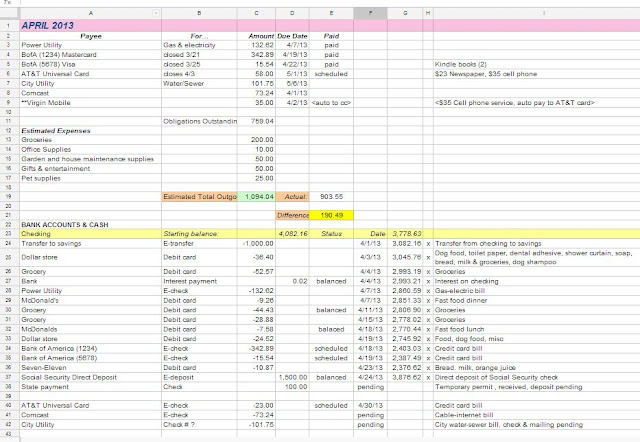
At some point I decided to just set up a Microsoft Excel spreadsheet to keep track of my finances. I started with one sheet for the current month and then added a sheet for each succeeding month. As time went on, I added more features, made changes, added some colors. It's still very simple, but it's fast and works very well for my admittedly simple finances. A few years ago I transferred it all to Google Spreadsheets, so it's all online. I keep a year's worth of spreadsheets in a single workbook, and then start a new workbook each January by making a copy of the current workbook and then changing the dates and updating.  Here's a sample page:


Below this most-used portion of the spreadsheet, I have sections for other bank accounts and even cash (although I haven't been keeping that current - I don't use cash much). I feel guilty about that.

This allows me to capture and predict the bills I have to pay each month. When I start each year's workbook by making a copy of the past year's, things like annual property taxes, insurance payments, and quarterly utility payments are automatically in the correct month. I then erase all the checking account entries from the past year, and adjust for any changes that have occurred since last year - new bills, new monthly amounts for internet and newspaper for example. Some bill amounts I won't know in advance, like utility and credit card bills. But at the beginning of the month I check each account online and predict, and then fill in the "official" amount when the bill arrives.

I also predict how much I think I will spend on the usual stuff: groceries, gifts, etc., and the spreadsheet adds this to the predicted bill payments, and puts the total in "estimated total outgo". The following "actual" field keeps track of all the expenditures from checking. Then the "difference" field shows me how much more I have to spend, or by how much I've exceeded my estimated budget.

The checking section is maintained regularly, with each check, check card purchase, or other electronic payment from checking entered, along with the date and what the payment was for. The amount shown in the header, right of "starting balance," is the account balance at the beginning of the month. I also enter income, such as my Social Security check and anything else that happens to show up, in a separate column just right of the column for expenditures. Every week I log in to my bank's website and check off items as they appear (in the "x" column), and balance their total with mine. The column to the left of the "x" column is my checkbook total. This way I can keep my checkbook balanced and up-to-date, as well as check for any charges I failed to enter or even bogus ones.

I also enter into the check list bills that will be paid later in the month, even amounts that are only estimated (I change them to the exact figure later, when the bill comes in). The amount shown in the header just right of "date" is a predicted account total for the end of the month, minus groceries and other miscellaneous debits from shopping, for instance, as it incorporates the predicted future entries, both expenditures and income. 

Another thing I do now, to keep track, is to add in credit card purchases in the top section of next-month's spreadsheet for each card. I always pay off credit card balances in full, so this lets me keep track of what my upcoming credit card payments will be.

Whew! Seems complicated, but it really isn't. For me, it's lightening-fast and makes balancing my accounts a matter of just minutes. Because I built it, I can change it any way I want. For a while I added columns to keep track of what I was spending on food, pet expenses, and other household expenses. It's been easy to go back and find specific information I've needed, too. It's maddening, though, to go back and see how much my Comcast bill has gone up over the last few years!

This method wouldn't be for everyone. I'm retired and don't have a lot of investments or other complications that the big financial software programs are really built for. I don't even have to itemize deductions, so record keeping for tax purposes is no longer an issue. But because I have dates and payees, and I save my receipts, it's easy enough to go back and retrieve information for purchases or other expenditures. You don't have to be a spreadsheet whiz to use this kind of system, as it uses only very simple summation formulas. You could make the spreadsheets do much, much more if you wanted to.

I've found that this easy little method really has allowed me to achieve more control over my money and how I spend it. I haven't paid a bank fee or even any interest in years! I can see right away when I'm spending too much in a given area. I always know where my money is and what's coming up. And since use of Google Docs is free, as is Google cloud storage for documents and spreadsheets created in their formats, it doesn't cost me a thing! This is what I really like: frugal AND better.

Saturday, January 24, 2015

Fancy Food... Frugal... and Not so Frugal

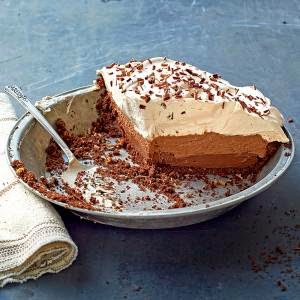
Ultimate Chocolate Pie - Not Frugal!
We had a very slushy nor'easter come through last night, and the sleety tail end definitely makes today an indoor day. A good day for making soup, for instance. I have some black beans and ham that are cooked and ready to use in soup... I'll just saute some onions, celery, and bell pepper, then add the black beans and their broth, trim and add some minced ham, and later some brown rice, chopped kale, and seasonings. Mmmm good, especially with a square of corn bread.

Now, I'm not a Facebook fan, but... sigh... many of my family members are on it, and so checking for family photos and news is a morning ritual. This morning's cruise through Facebook yielded a tip for a very fancy chocolate pie. I'm sure it is delicious, but a quick scan through the loooooong ingredient list told me that this would be a very expensive recipe to make. Several different kinds of chocolate and chocolate candy, and purchased chocolate wafers for the crust (something not available in many smaller markets, at least in my area.)

And that got me thinking about frugality in cooking "special" things for company or a festive Sunday dinner. I see so many recipes like this chocolate pie. They look delicious, but the ingredients include things that are unusual, and/or expensive, rather than the basic things we buy on a regular basis and have on hand. We're used to seeing this in upscale magazines, but nowadays even lower-brow publications seem to feel that you need to have a few "gourmet" ingredients in a recipe or it's just not sufficiently unique to publish. Add in the trend for using a lot of prepared food ingredients in recipes, such as bottled sauces, crackers or candies, and there seem to be very few frugal recipes around.

Now, my goal is not just to cook cheaply, but to do it with some flair. I like to make delicious, even impressive meals, especially for company, but I don't like to spend a whole week's grocery budget on one meal! The solution I've found is to specialize in classic, even historical, American cookery. The best in American cooking is very good indeed, and worthy of perpetuation, I think. Most people find it interesting and nostalgic. especially when you can provide some history for your recipes.

For example, I read in a novel about something called "vinegar pie." Apparently the pioneers, not having fresh lemons available, made pies with vinegar in place of lemon, to give that tangy sweet-sour flavor. I found a recipe for a vinegar pie in a Martha Stewart cookbook, and prepared it for a pot-luck supper. Not only did everyone love it, but they were enchanted with its backstory. And it was quite inexpensive to prepare, too.

For me, James Beard's American Cookery is the best in my collection of classic American cookbooks, in part because he gave so much interesting historical information along with the recipes. And I don't think there is a bad recipe in the book! But I keep my eye out for older cookbooks at library sales, yard sales, and used book stores, too, where I've gotten some gems for a dollar or two. Specializing in this type of cookery, I can often do all my shopping at my local discount grocery, which sells most of the basic ingredients used in these types of recipes, and don't have to search around town for more exotic and usually expensive ingredients.

Google.com is also a good source of historical recpies and their backstories. (By the way, I consider a recipe to be "of historic interest" if it originated in the 1950's or earlier.) Another good source is Allrecipes.com, which has the advantage of a lot of user reviews and comments. If I hear or read about an old recipe that sounds interesting, I Google it and usually get lots of hits. Last year, I found an old recipe I'd lost for Cranberry Cumberland Sauce (not really frugal, as you have to buy currant jelly and port wine, but delicious for Thanksgiving) this way.

Vinegar Pie - Frugal
Speaking of vinegar pie, I just Googled it and found (a) lots and lots of recipes, and (b) a very interesting blog post with nice pictures. It looks just like the vinegar pie I made years ago. No Google back then! It's definitely a frugal and delicious dessert recipe. I also learned that vinegar pie is mentioned by Laura Ingals Wilder in her books.


Friday, January 23, 2015

Reading the Godmother of Frugality

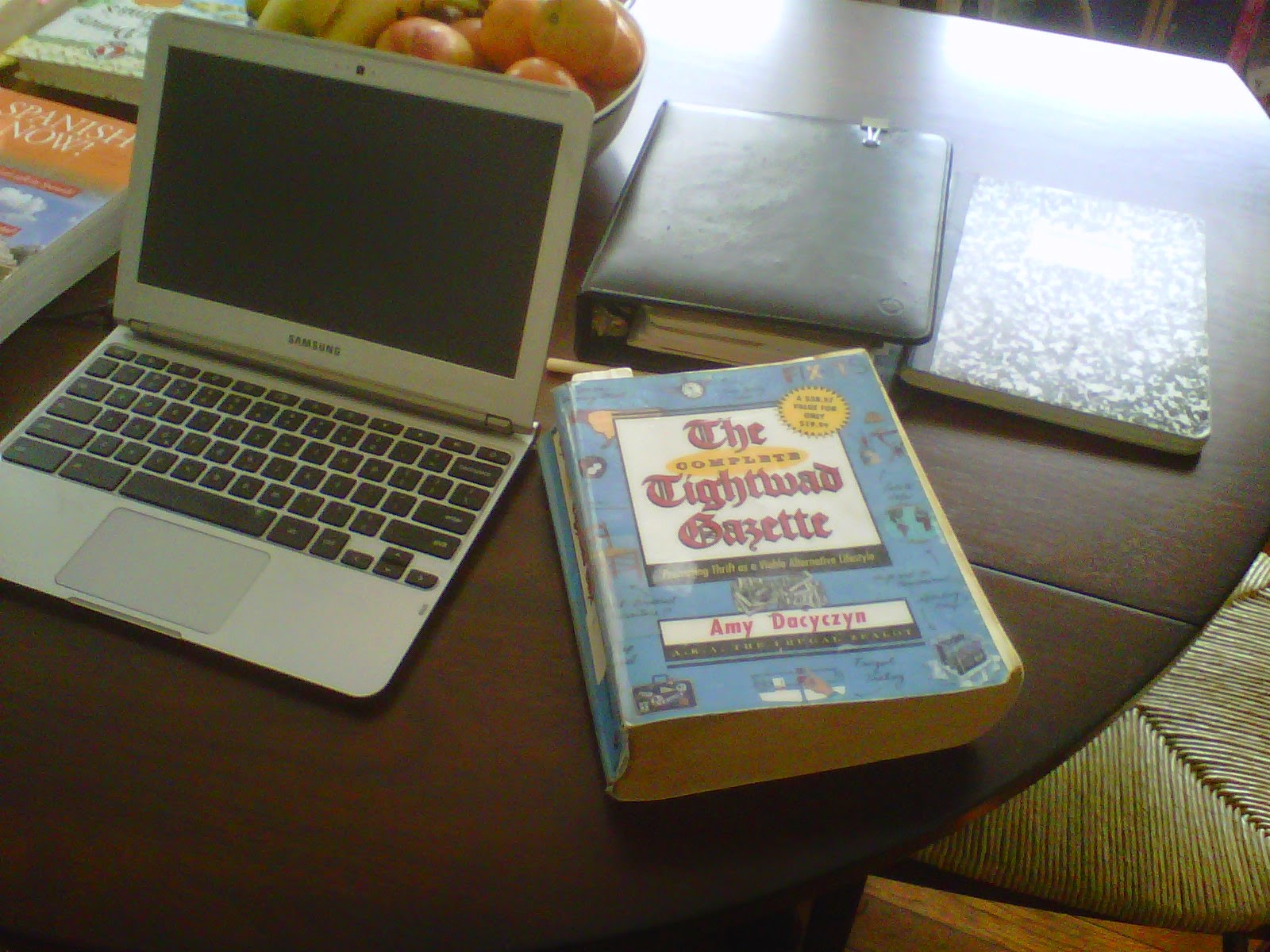
I got a copy of Amy Dacyczyn's The Complete Tightwad Gazette, and I've been having fun starting to read through it. I got it from the library's interlibrary loan, of course, but it is still in print. This is a compendium of most of the articles from the full run of her newsletter, previously collected in three separate volumes, plus some additional material that postdates the last book. Amy is the godmother of frugality, referred to by just about everyone who currently writes on the topic, and I suspect millions of people have been affected, directly or indirectly, by her work.

As you can see, it' s a huge book, nearly 1,000 pages! I remember reading one of the smaller books years ago, and thought much of it would be very dated by now. In some respects a lot is, but Amy was always trying to teach general principles, rather than just specific strategies. And that still works.

I found several usable ideas in just the first 40 pages:

  • I've been wanting a way to store my double-pointed knitting needles so that I can quickly find the size I need. No more rummaging! On page 20 I found instructions for a roll-up fabric holder for children's school supplies that I could readily adapt for needles. Perfect! I'd been thinking of buying a similar-type holder... expensive and not adapted to some extra-long needles I have. 
  • A homemade granola recipe appears on page 27. The recipe calls for 1/3 cup vegetable oil. Well, nowadays we know that vegetable oils are not healthy. Used in anything but minimal quantities they are associated with higher cancer incidence and undesirable polyunsaturated fatty acid ratios. Back when Amy wrote this, seed and grain oils were being touted as health foods. Yet another example of "expert opinions" that somehow become totally wrong in a couple of decades, right? But that's another story. Currently, a quick Google search (searchwords: granola recipe without oil) yielded many yummy-looking recipes. I have always liked a warm-weather breakfast of granola, yogurt, and fresh fruit. So I'll try making some homemade granola when the weather warms up. Who knows? Maybe I'll graduate to making my own yogurt, too! Both are quite a bit cheaper and healthier when made in your own kitchen from basic, wholesome  ingredients.
  • Instructions for making envelopes from wasted paper are found on page 38. I do a lot of printing of lesson plans, and always end up putting tons of paper in the recycling bin. This looks super easy, needs just a bit of glue or a glue stick, and will allow me to use at least a little of the paper for something useful. And if I make homemade "art cards," as I'd like to, this would solve the envelope problem.

Amy was (and apparently still is) an unrepentant, in-your-face tightwad. Her philosophy is that for many people, the key to a better life is NOT in making more money, but in using their existing money and other resources more effectively. The main difference between her and me, I think, is that she is proudly, flamboyantly cheap, while I tend to practice what I have come to think of as Stealth Frugality.

I've just found over many years that being "cheap" elicits negative responses from some people. I was perhaps 9 or 10 years old when I suggested to a group of friends that we take the long way over the bridge so we didn't have to pay the ferry fare, and was taunted as a "cheapskate" for months afterward. (Kids can be such little meanies, can't they?) We all lived in a pretty upscale beach town and our families were all comfortable (or better), but while my mother taught the virtues of frugality, conspicuous consumption was clearly being modeled in other homes. Even now, I find that referring to my frugal ways can make some people uncomfortable. So I have come to embrace the concept of Stealth Frugality, in which you live well on a lot less than many others, but use taste and creativity and canniness to make that difference invisible or at least much less apparent.

I like the big ol' Tightwad Gazette book so well, in fact, that... I decided to order a copy. It's only $13.92 in paperback from Amazon.com, but I found it in "very good" condition from one of Amazon's used book sellers, for $10.49. Three dollars is three dollars, and I've had good luck with the used book dealers who sell through Amazon.


Tuesday, December 2, 2014

Why and How You Can Compute "In the Cloud" and Save

I was listening to the radio tech guru Kim Komando this morning. She advertises a cloud computer backup service that you pay about $5.00 a month for. Not bad, but you can have just about everything you do backed up "in the cloud"... for free... with just a tiny bit of effort.

If you read about computers at all, a lot of the talk is about "cloud computing"  and "cloud backup." In the old days of computing (a few years ago), everybody was buying computers with bigger and bigger hard drives. Basic brand-name software, such as Microsoft Office, kept getting more bloated and more expensive. You downloaded all your e-mail to Outlook and kept it on your hard drive.

But "cloud computing" is here, and is a very frugal alternative to all that expensive hardware and software. You store most of your documents - e-mail, photos, letters, journals, music, video - on somebody else's server (such as Microsoft's, Amazon's, or Google's... see below) and use it directly from the internet, You can  download or stream it from the internet when you need it. There's also a growing body of "cloud software" that you use only online. No more buying expensive software packages and installing them on your computer (although a growing trend is to charge you a subscription fee for premium versions of free online software). The nice thing is that with cloud computing, you can get away with using a computer with much less hard memory, and that is far less expensive. My latest computer, a Chromebook, takes care of most of what I do and cost $249, about a thousand dollars less than my previous one.

The cost of cloud computing can indeed be very low. There are a lot of reliable, big-name sources of cloud storage that are free or very cheap. You can use free storage from several of them and never pay a dime. I like to use Evernote for clips from the web, Google for e-mail, pictures, many documents, and MP3 storage. I store some pictures and MP3s on Amazon, too. Microsoft's cloud has Word and Excel documents and various pdf files I download from the web, including a lot of knitting patterns. All this is free. For the sake of sanity, I'd advise using each service for specific types or categories of files, so you never have to hunt around through multiple sites.

Here are brief summaries of the cloud storage services I use:
  • Google Drive charges an astonishing low $1.99 a month for 100 gigabytes (GB) of storage, but you get 15 GB free for using Google Drive (their cloud-based document production and  storage utility), which is shared across picture and e-mail storage and is enough for many people without the need to pay for any more. It helps that documents created in Google Drive, and smaller pictures stored in Google+, don't count towards your storage limit. I have a ton of documents and e-mail and photos stored in Google's cloud, but when I last checked I had less than 8 GB of storage that counted towards my limit. I create all my teaching lesson plans and handouts in Google Docs now, but because I do them within the Docs platform, I'm not charged for storage, even though most contain multiple cut-and-pasted pictures.
  • Microsoft's OneDrive is obviously competing with Google, and now also gives you 15 GB for free, and another 100 GB for $1.99 a month. With that, you get free use of Microsoft's online Office suite, including Outlook.com for e-mail and Onenote. These versions aren't as robust as the insanely complicated Office suites I used until recently... but they do the job and are free. If you're a die-hard Microsoft user, this would be a good option.
  • Amazon's Cloud Drive is gradually becoming a bit more user-friendly, but it doesn't have the associated e-mail and document creation platforms that make both Google and Microsoft storage so handy. Still, Amazon's Cloud Drive does give you 5 GB of free storage, with a pricier 100 GB at $50/year. Photo storage is free and unlimited for Amazon Prime users. Not worth it at the $99/year Prime cost, but if you're already a subscriber you should take advantage.
  • Dropbox was one of the first successful cloud storage apps and has been a favorite for years. It provides 2 GB of free storage, or up to 1,000 GB (1 TB) for $9.99/month. Reliable and intuitive, it's one of the best ways to transfer files from one device to another. Like Amazon's Cloud Drive, you'll need to rely on your own software as Dropbox has no associated e-mail, calendars, or file creation services.
  • Evernote isn't usually thought of as cloud storage, but that is what it does, mostly. I'm an admirer of Evernote, by the way. It provides unlimited free cloud storage for all your documents and other files, but there are some limitations. File size and monthly upload limits exist for users who don't subscribe to the premium service, which is $5.00/month or $45.00/year. Evernote has really robust filing, tagging, and search features, and you can retrieve your files from a large variety of platforms. It even works well on my ancient Blackberry Curve.
  • There are quite a few other cloud storage services, and many offer some limited free use in hopes you'll like them and pay for more. I've checked out a few, including Sugarsync and Box.com, and I know there are a lot more. I guess my preference is to stay with the better-known services, but some of these have been around for quite a while.
You may have some valid concerns re using these services. Privacy is one, and since everything gets hacked these days, I wouldn't store sensitive confidential information in any of these places. Also, be aware that these are all businesses that could go belly-up or change policies at any time. Have a back-up plan in case your service announces it's going away, so you can move stored documents in a hurry. I've also heard of people getting locked out of Google or Microsoft accounts, and thus losing access to their stored documents for a long time while trying to regain access. I try to keep anything truly critical backed up in a second location and usually as a hard copy, too. But with these few precautions, I find using cloud computing to be a great money and worry saver.

Thursday, November 27, 2014

Gratitude

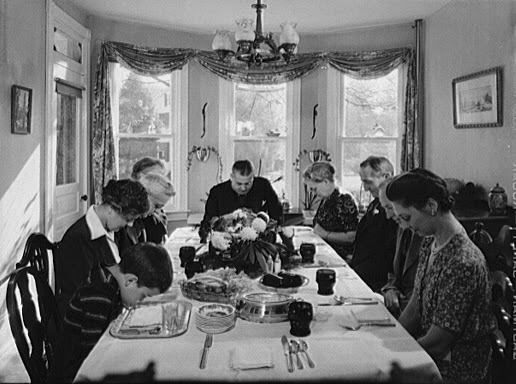
Thanksgiving Grace: 1942
This annual coming-together to think and express what we're thankful for is pretty much a uniquely American phenomenon. As a nation, right from our beginnings we've understood the value of recognizing and expressing gratitude for our blessings.

But the individual and daily exercise of gratitude has become even more important to me as part of the process of creating a good life.

Now, gratitude is the subject of a lot of books and countless articles. In addition to its spiritual and psychological benefits, gratitude is even recommended as part of the "manifestation" process described in The Secret and similar books. As in, if you get it and aren't grateful, the universe will stop being so generous.

At minimum, being grateful does move your focus to the positive. And I think much of how we evaluate the quality of our lives is a function of that focus. It used to be popular to pooh-pooh the supposedly saccharin story in the children's book Pollyanna, by Eleanor H. Porter, but I've found a lot of benefit in that approach. You notice what you're focusing on, and that can really change your perception of how things are. And with a bit of consistent effort, you can change your focus. One way to do that is to consciously practice gratitude on a daily basis. Some people keep gratitude journals as part of that practice. By the way, I'd recommend a re-read of Pollyanna... I read it again a few years ago and thoroughly enjoyed its charming story. And if you're trying to summon up more gratitude, it will definitely reinforce your effort.

Changing your focus to what you're grateful for is also recommended as a key strategy by self-help guru Tony Robbins. He stresses, over and over in his work, that what you focus on is what you get more of.

So perhaps there is some kind of woo-woo magic, per The Secret, in focusing on what you want, in order to manifest it. Or maybe it's just a psychological phenomenon that whether you focus on good things, or undesirable things, your subconscious will "help you" by working behind the scenes to bring you that which you're focusing on. And religious folks, of course, will realize the spiritual discipline of being grateful for whatever is brought into your life.

Today I'm grateful for many things. Among them is the ability to be profoundly grateful for what I have.